Key highlights
- Spreadsheets work well for small businesses but limit growth.
- Manual processes lead to errors, duplicate data, and version confusion.
- Poor inventory visibility can cause stock shortages and overstocking.
- Manual reporting delays business decisions.
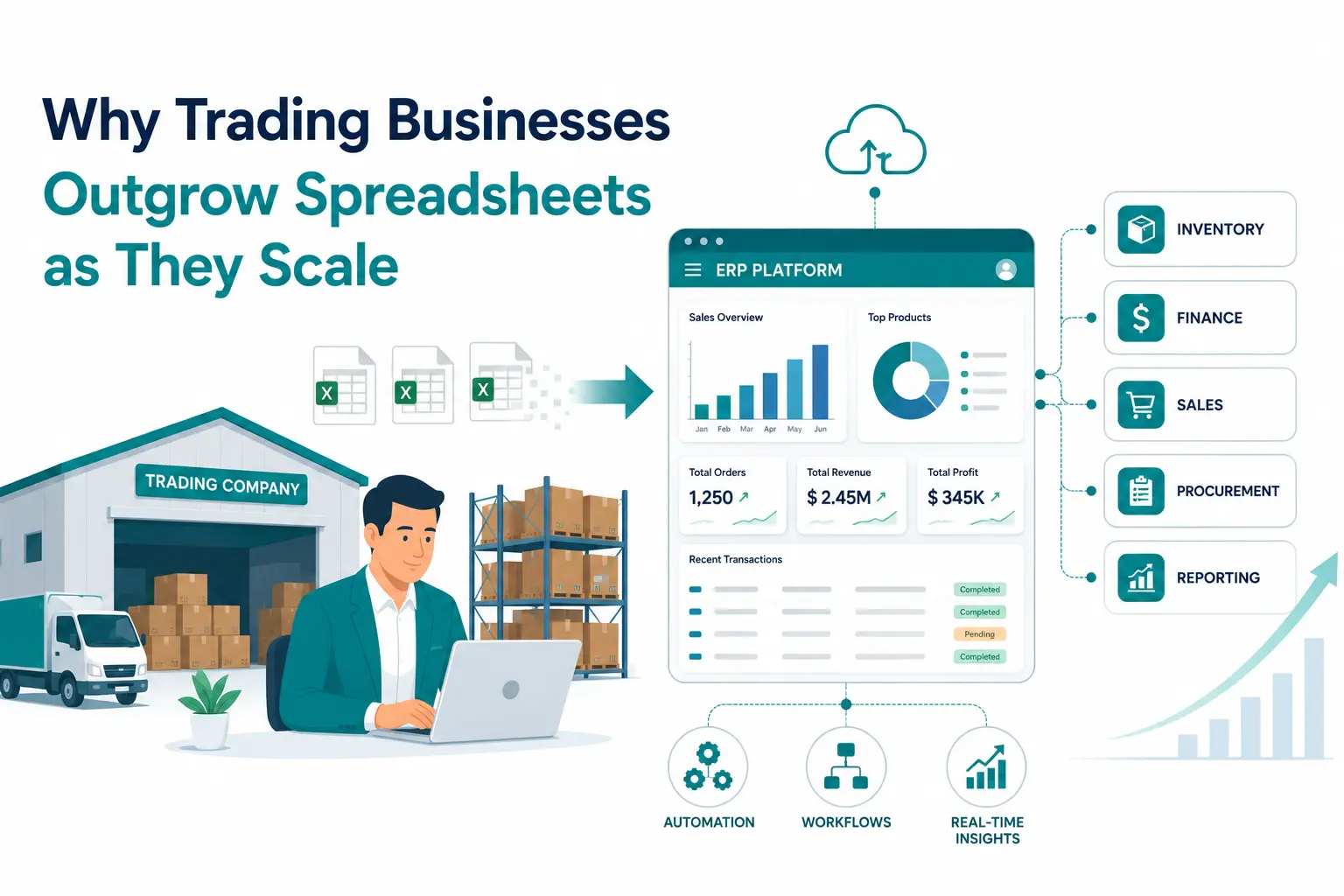
- ERP centralizes inventory, finance, sales, and procurement in one system.
- Real-time dashboards provide instant business insights.
- Automation reduces manual work and improves productivity.
- Cloud ERP supports secure access and business scalability.
- Growing businesses should adopt ERP before inefficiencies increase.
- Digital transformation helps trading businesses operate smarter and grow faster.
Why Trading Businesses Outgrow Spreadsheets (And What Comes Next)
For many trading businesses, spreadsheets are where everything begins. They are affordable, easy to use, and familiar to almost everyone. Whether you’re managing inventory, tracking purchases, recording sales, or monitoring finances, spreadsheets offer a simple way to organize business data during the early stages.
However, as your business grows, so does the complexity of your operations. More customers, suppliers, warehouses, employees, and transactions mean more data to manage. What once worked perfectly soon becomes a source of delays, mistakes, and operational bottlenecks.
This is one of the main reasons why trading businesses outgrow spreadsheets. Manual systems simply cannot keep pace with modern business demands.
In this guide, we’ll explore the biggest spreadsheet limitations, compare spreadsheets vs ERP, and explain why many businesses across Bahrain and the GCC are embracing digital transformation with integrated ERP solutions.
Why Spreadsheets Work Until They Don’t
It’s easy to understand why spreadsheets are the preferred choice for startups and small trading businesses.
They offer several advantages during the early stages:
- Low setup cost
- Minimal training required
- Easy customization
- Suitable for small teams
- Good for basic record keeping
- Flexible enough for simple calculations
For businesses handling limited transactions, spreadsheets are often more than enough.
The challenge begins when growth accelerates.
As operations expand, businesses start managing larger inventories, multiple suppliers, growing customer databases, several warehouses, and increasingly complex financial records. Teams also become larger, meaning multiple people need access to the same information simultaneously.
At this stage, spreadsheets start creating more work instead of saving time.
Signs Your Trading Business Has Outgrown Spreadsheets
Many businesses don’t realize they’re spending valuable time managing spreadsheets instead of managing the business.
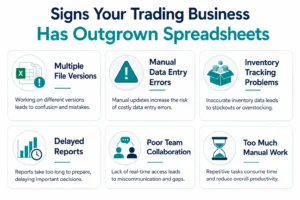
Here are some common warning signs.
Multiple Versions of the Same File
Different departments maintain separate spreadsheets. Finance has one version, sales another, and procurement yet another. Eventually, nobody knows which file contains the latest information.
Frequent Data Entry Errors
Manual copy-pasting, typing mistakes, broken formulas, and missing information become increasingly common.
Even a small mistake can affect inventory counts, financial reports, or customer orders.
Delayed Reporting
Creating weekly or monthly reports often requires collecting information from multiple spreadsheets.
Instead of accessing reports instantly, employees spend hours combining data manually.
Difficulty Tracking Inventory
As stock moves between warehouses or branches, updating spreadsheets becomes increasingly difficult.
Without accurate inventory visibility, businesses risk stock shortages or overstocking.
Duplicate Records
Customer information, supplier details, and product data often get entered multiple times across different spreadsheets.
This creates inconsistencies throughout the business.
Slow Approval Processes
Purchase approvals, sales quotations, and payment requests often rely on email chains and manual follow-ups.
The result is slower decision-making and delayed operations.
Too Much Manual Work
If your team spends more time updating spreadsheets than serving customers or growing the business, it’s probably time to consider a better solution.
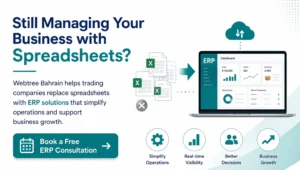
As trading businesses grow, replacing spreadsheets with an ERP system becomes a practical next step. An ERP centralizes inventory, procurement, sales, finance, and warehouse operations into a single platform, helping businesses improve accuracy, automate workflows, and gain real-time visibility. Learn about the essential ERP features every trading company should look for before choosing a solution.
The Biggest Limitations of Spreadsheets
Although spreadsheets remain useful for simple tasks, they were never designed to run growing trading businesses.
No Real-Time Inventory Visibility
Inventory changes constantly.
Products are purchased, sold, transferred between warehouses, returned, or reserved for customers throughout the day.
Spreadsheets only reflect the information entered manually. This means inventory records can quickly become outdated.
Without real-time stock visibility, businesses may:
- Oversell products
- Miss purchase opportunities
- Delay customer deliveries
- Carry excess inventory
- Lose sales because of inaccurate stock levels
Modern inventory management software provides instant updates across every warehouse and branch.
Manual Data Entry Increases Errors
Every manual task introduces risk.
Common spreadsheet problems include:
- Copy-paste mistakes
- Incorrect formulas
- Missing transactions
- Duplicate entries
- Accidental deletion of important data
As transaction volumes increase, these mistakes become more frequent.
Correcting errors often consumes even more time than creating them.
Collaboration Becomes Difficult
Trading businesses involve multiple departments working together every day.
- Sales needs inventory information.
- Finance needs purchasing records.
- Warehouse teams require shipping updates.
- Procurement needs supplier information.
With spreadsheets, collaboration often looks like this:
- Files emailed back and forth
- Multiple versions saved locally
- Information overwritten accidentally
- Employees waiting for someone else to close a file
Instead of improving teamwork, spreadsheets create communication gaps.
Limited Reporting and Business Insights
Business leaders need reliable information to make informed decisions.
Unfortunately, spreadsheets make reporting slow and difficult.
Without integrated reporting, businesses struggle to:
- Forecast demand
- Track profitability
- Monitor KPIs
- Analyze sales performance
- Understand purchasing trends
- Identify slow-moving inventory
When reports take days to prepare, opportunities may already be lost.
Weak Security and Audit Trails
Business information should only be accessible to authorized employees.
Spreadsheets offer limited security.
Some common concerns include:
- Anyone with access can edit data
- No detailed audit history
- Limited user permissions
- Difficulty identifying who changed information
- Increased compliance risks
As businesses grow, protecting operational and financial data becomes increasingly important.
Spreadsheet vs ERP: What’s the Difference?
The debate around spreadsheets vs ERP isn’t about replacing spreadsheets entirely. It’s about choosing the right tool for business growth.
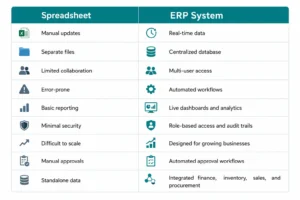 While spreadsheets remain useful for calculations and planning, ERP systems are designed to manage entire business operations from one platform.
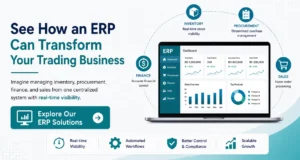
How ERP Solves These Challenges
Modern ERP for trading companies brings every department together through a single integrated system.
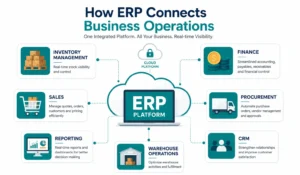
Instead of maintaining disconnected files, everyone works from the same source of information.
Centralized Business Data
Customer information, inventory, purchasing, finance, suppliers, and sales all exist in one database.
Every department accesses the same real-time information.
Smarter Inventory Management
ERP systems provide accurate inventory visibility across warehouses, branches, and sales channels.
Businesses always know:
- Current stock levels
- Incoming inventory
- Reserved stock
- Reorder points
- Product movement history
Procurement Automation
Purchase requests, supplier approvals, and purchase orders can all be automated.
This reduces paperwork while improving purchasing efficiency.
Sales and Finance Integration
When a sales order is created, inventory updates automatically.
Invoices can be generated instantly, while accounting records remain synchronized.
This eliminates duplicate data entry across departments.
Real-Time Dashboards
Business owners no longer wait until month-end reports.
ERP dashboards provide instant visibility into:
- Sales performance
- Inventory levels
- Outstanding payments
- Purchase orders
- Financial health
- Operational KPIs
Approval Workflows
Routine approvals can be automated based on predefined rules.
This reduces delays while maintaining accountability.
Better Collaboration
Everyone works within the same system.
Sales, finance, procurement, warehouse, and management teams always have access to the latest information.
This is one of the biggest advantages of business process automation.
When Should a Trading Business Upgrade to an ERP?
Every business grows differently, but several situations often indicate it’s time to move beyond spreadsheets.
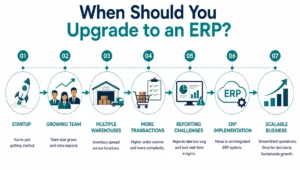
Consider upgrading when you:
- Manage multiple warehouses
- Operate across different branches
- Process hundreds of transactions every month
- Spend excessive time creating reports
- Employ multiple departments using different spreadsheets
- Frequently experience inventory discrepancies
- Want faster decision-making
- Plan to expand into new markets
Waiting too long often means businesses continue absorbing unnecessary costs through manual work and operational inefficiencies.
Benefits of Moving Beyond Spreadsheets
Investing in ERP isn’t simply about replacing spreadsheets.
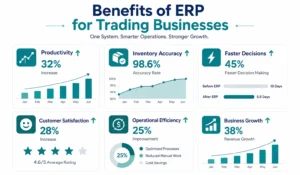
It’s about improving how the entire business operates.
Some key benefits include:
Better Productivity
Employees spend less time entering data and more time delivering value.
Fewer Manual Errors
Automation significantly reduces human mistakes.
Faster Decision Making
Real-time dashboards help leaders respond quickly to changing market conditions.
Improved Customer Service
Accurate inventory and faster order processing improve customer satisfaction.
Higher Operational Efficiency
Integrated processes eliminate duplication and unnecessary manual work.
Business Scalability
ERP systems support long-term growth without requiring businesses to redesign processes every few years.
Why Bahrain Trading Companies Are Digitizing Their Operations
Businesses across Bahrain are investing heavily in digital transformation. Several factors are driving this shift.
Increasing Regional Competition
Trading companies must operate more efficiently to remain competitive across GCC markets.
Cross-Border Trade
Managing suppliers, logistics, currencies, and documentation becomes easier with integrated business systems.
Cloud Adoption
Modern Cloud ERP Bahrain solutions allow businesses to access operations securely from anywhere while reducing IT infrastructure costs.
Greater Demand for Operational Efficiency
Customers expect faster deliveries, accurate inventory, and quicker service.
Manual systems make meeting these expectations increasingly difficult.
Digital Transformation Initiatives
Businesses across Bahrain are embracing digital technologies to improve productivity, reduce operational costs, and support long-term growth. Moving beyond spreadsheets isn’t just about adopting new software. It’s about rethinking how your business operates. A well-planned digital transformation strategy helps trading companies integrate systems, automate workflows, improve decision-making, and build a scalable foundation for growth. Explore our guide to digital transformation for trading companies to understand the next steps in your transformation journey.
From Manual Processes to Smarter Operations
Growing trading businesses eventually reach a point where spreadsheets begin limiting growth instead of supporting it.
Disconnected files, manual reporting, inventory errors, and inefficient workflows reduce productivity and increase operational risk.
Successful businesses address these challenges by adopting integrated ERP solutions that centralize operations, automate routine processes, and provide real-time visibility across departments.
Digital transformation isn’t simply about adopting new software. It’s about creating a smarter way of working that enables businesses to scale with confidence.
At Webtree Bahrain, we help trading companies modernize operations through ERP consulting, custom software development, process automation, and cloud-based business solutions tailored to their unique workflows.
Whether you’re managing inventory across multiple warehouses, improving procurement processes, or integrating finance with sales operations, our solutions are designed to support long-term business growth.
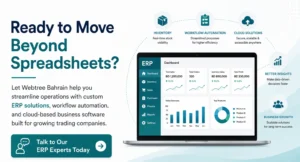
How Webtree Bahrain Can Help
Webtree Bahrain helps trading businesses replace disconnected spreadsheets with intelligent, scalable business solutions that improve efficiency and support growth.
Our expertise includes:
- ERP consulting and implementation
- Custom business software development
- Business process automation
- Inventory and warehouse management solutions
- Cloud ERP implementation
- AI-powered reporting and analytics
- CRM, finance, and eCommerce integrations
- Ongoing support, optimization, and system enhancements
Whether you’re beginning your digital transformation journey or looking to modernize existing operations, Webtree delivers solutions that align with your business goals.
Webtree Bahrain helps businesses across Bahrain and the GCC streamline operations with custom ERP systems, cloud solutions, and intelligent automation. By replacing manual processes with integrated digital platforms, you gain greater visibility, improved efficiency, and the flexibility to scale with confidence.
Frequently Asked Questions
Why do trading businesses outgrow spreadsheets?
As businesses grow, spreadsheets become difficult to manage due to manual data entry, limited collaboration, lack of real-time visibility, version control issues, and increased risk of human error.
When should a business replace spreadsheets with ERP?
Businesses should consider ERP when they manage multiple departments, warehouses, increasing transaction volumes, or require real-time reporting, automation, and centralized business data.
Can spreadsheets handle inventory management?
Spreadsheets can manage small inventories effectively, but they become difficult to maintain as stock levels, warehouses, suppliers, and transactions increase. Dedicated inventory management software offers greater accuracy and real-time visibility.
What are the biggest risks of using spreadsheets?
The most common risks include broken formulas, duplicate records, manual data entry errors, poor collaboration, limited security, missing audit trails, and inconsistent reporting.
Is ERP suitable for small and medium trading businesses?
Yes. Modern cloud ERP solutions are scalable and can be implemented gradually, making them suitable for SMEs as well as larger trading enterprises.