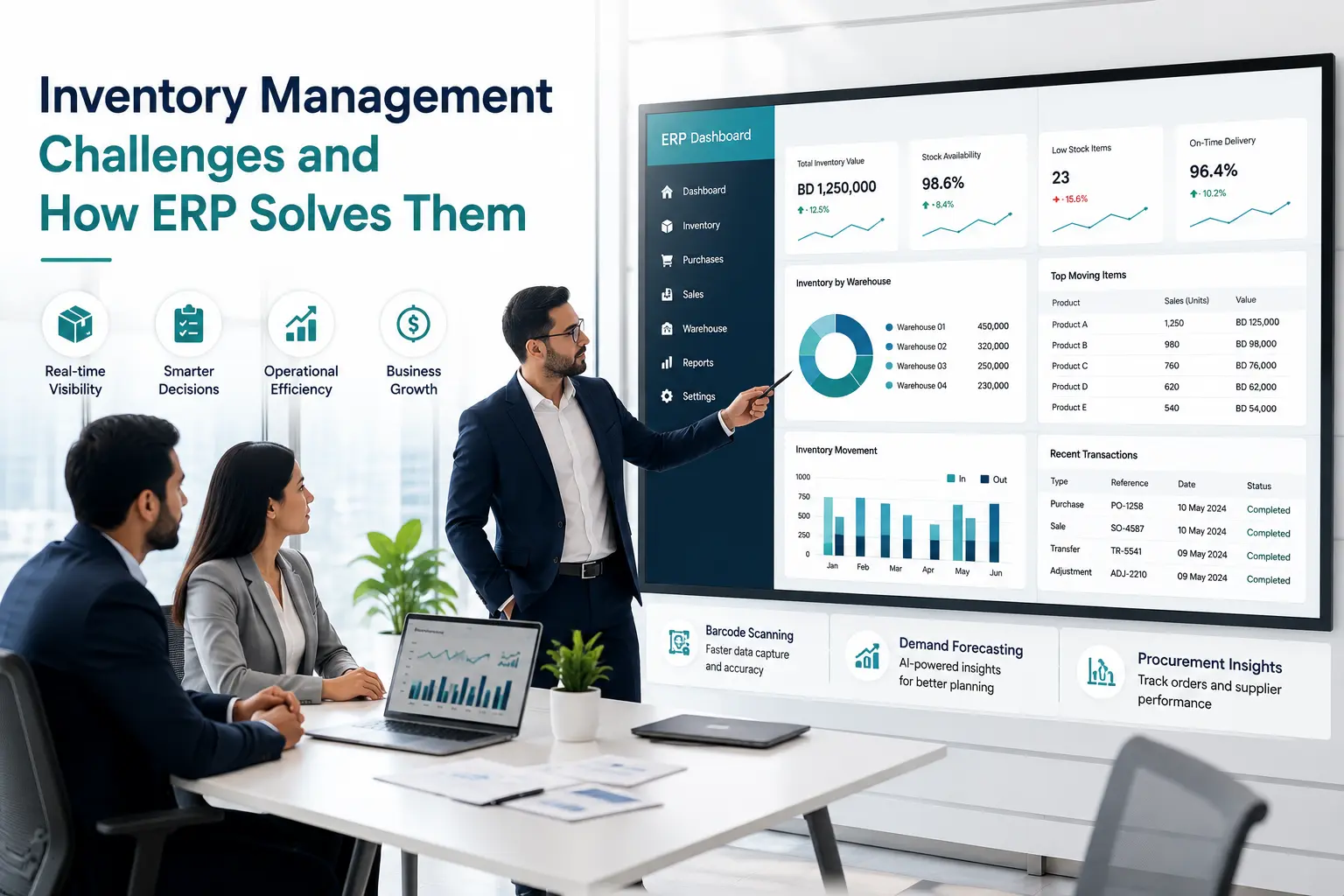
Key Highlights
- Gain real time visibility across all inventory locations.
- Reduce stockouts and overstocking with ERP automation.
- Eliminate manual inventory errors using barcode integration.
- Improve demand forecasting with AI powered insights.
- Streamline warehouse and procurement operations.
- Track inventory with batch and serial number management.
- Manage multiple warehouses from a single ERP platform.
- Help your business scale with cloud ERP solutions from Webtree.
Inventory is one of the most valuable assets for any trading, manufacturing, or distribution business. Managing it effectively can mean the difference between healthy cash flow and costly operational disruptions. Yet many businesses continue to rely on spreadsheets, disconnected software, or manual processes that make inventory difficult to control.
Poor inventory management can lead to overstocking, stock shortages, delayed deliveries, excess storage costs, and dissatisfied customers. These inventory management challenges not only affect day-to-day operations but also limit a company’s ability to scale.
This is where ERP inventory management becomes a game changer. A modern ERP system connects inventory, purchasing, sales, finance, and warehouse operations into a single platform. With real-time visibility and automation, businesses can make smarter decisions, improve inventory accuracy, and increase profitability.
Whether you’re a trading company, wholesale distributor, or import-export business in Bahrain or the GCC, investing in the right inventory management ERP solution can transform your operations.
According to IHL Group, the global cost of inventory distortion caused by stockouts and overstocks has reached approximately US$1.77 trillion, highlighting the enormous financial impact of poor inventory management across industries.
Why Inventory Management Is Critical for Growing Businesses
As businesses grow, inventory becomes more complex. More suppliers, larger product catalogs, multiple warehouses, and increasing customer expectations make manual inventory tracking unsustainable.
Effective inventory management directly impacts:
- Customer satisfaction through timely order fulfillment
- Working capital by reducing excess inventory
- Warehouse efficiency with organized stock movement
- Procurement planning through accurate purchasing decisions
- Overall business profitability by minimizing waste and improving stock turnover
Without reliable inventory management software, businesses often struggle to maintain the right balance between inventory availability and operational costs.
Common Inventory Management Challenges
Poor Stock Visibility
One of the biggest inventory control challenges is not knowing exactly what inventory is available at any given moment.
Businesses operating across multiple warehouses often use different spreadsheets or disconnected software systems. This creates inconsistent stock records and inaccurate inventory counts.
Common issues include:
- Duplicate inventory records
- Products appearing available when they’re actually out of stock
- Difficulty locating inventory across warehouses
- Delayed stock updates
How ERP Solves It
An integrated ERP inventory management system creates a centralized inventory database.
Benefits include:
- Live inventory updates
- Multi-location stock visibility
- Centralized inventory records
- Real-time product availability
Overstocking and Stockouts
Finding the right inventory balance is difficult.
Ordering too much ties up capital, increases storage costs, and risks product obsolescence.
Ordering too little leads to:
- Lost sales
- Emergency purchasing
- Production delays
- Customer dissatisfaction
How ERP Solves It
Modern inventory management ERP software uses automation to maintain optimal stock levels.
Key features include:
- Automated reorder points
- Low-stock notifications
- Demand forecasting
- Safety stock calculations
This helps businesses purchase inventory based on actual demand rather than guesswork.
Manual Data Entry and Human Errors
Many businesses still update inventory manually using spreadsheets.
While this may work initially, it quickly becomes inefficient as operations grow.
Common problems include:
- Duplicate entries
- Incorrect stock quantities
- Delayed updates
- Formula errors
- Time-consuming reconciliations
How ERP Solves It
ERP automates inventory transactions throughout the business.
Features include:
- Barcode scanning
- Automatic stock updates
- Integrated purchasing
- Automated inventory adjustments
With less manual intervention, businesses significantly reduce errors while improving productivity.
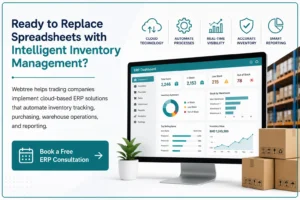
Instead of manually checking several systems, teams can instantly see inventory levels across every warehouse.ERP is often the foundation of a company’s digital transformation journey. When combined with automation, analytics, and connected business processes, it enables trading companies to improve collaboration, increase operational visibility, and make faster business decisions. Read our guide on digital transformation for trading companies to learn how ERP fits into a complete transformation strategy.
Inaccurate Demand Forecasting
Customer demand constantly changes due to:
- Seasonal trends
- Market conditions
- Promotional campaigns
- Supplier delays
Without reliable forecasting, purchasing decisions become reactive rather than strategic.
This often results in:
- Excess inventory
- Frequent stock shortages
- Poor purchasing decisions
- Increased carrying costs
How ERP Solves It
Today’s ERP systems analyze historical sales data and purchasing trends to improve forecasting accuracy.
Capabilities include:
- Historical sales analysis
- AI-powered demand forecasting
- Purchase planning
- Sales trend analysis
Businesses can anticipate future demand instead of reacting to it.
Research by McKinsey shows that AI-enabled demand forecasting can reduce forecast errors by 20–50% while significantly lowering stockouts, making predictive inventory planning a key advantage for businesses adopting modern ERP systems.
Lack of Traceability
Traceability is becoming increasingly important for businesses handling large inventories.
Without proper tracking, businesses struggle with:
- Product recalls
- Supplier verification
- Compliance requirements
- Warranty management
How ERP Solves It
Modern ERP solutions provide complete inventory traceability through:
- Batch tracking
- Lot numbers
- Serial number management
- Supplier history
- Full audit trails
This improves compliance while making product tracking much easier.
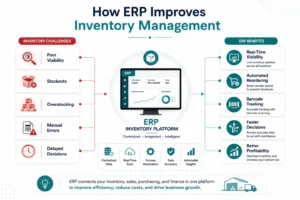
How ERP Improves Inventory Management
ERP does much more than track inventory quantities.
It connects every department involved in inventory movement.
Key improvements include:
Real-Time Inventory Visibility
Every stock movement is updated immediately, giving decision-makers accurate inventory information at all times.
Procurement Integration
Purchase orders automatically update inventory once goods are received, eliminating duplicate data entry.
Sales Integration
Sales orders immediately reserve available inventory, preventing overselling.
Warehouse Management
Warehouse teams can:
- Locate products faster
- Optimize storage
- Track stock movements
- Improve picking accuracy
Automated Workflows
ERP automates repetitive tasks such as:
- Purchase approvals
- Stock replenishment
- Inventory transfers
- Notifications
Reporting Dashboards
Managers gain access to live dashboards showing:
- Inventory valuation
- Stock turnover
- Fast-moving products
- Slow-moving inventory
- Warehouse performance
Before implementing an ERP system, it’s important to understand why traditional spreadsheet-based inventory management becomes unsustainable as businesses grow. Explore our guide on why trading businesses outgrow spreadsheets to see the operational limitations that drive the need for digital systems.
Inventory Challenges vs ERP Solutions
| Inventory Challenge | How ERP Solves It |
|---|
| Poor stock visibility | Real-time inventory tracking |
| Stockouts | Automated replenishment |
| Overstocking | Demand forecasting and reorder planning |
| Manual errors | Barcode scanning and workflow automation |
| Warehouse inefficiencies | Centralized warehouse management |
| Limited traceability | Batch and lot tracking |
| Delayed reporting | Live dashboards and analytics |
Essential ERP Features for Inventory Management
When evaluating inventory management software, businesses should prioritize features that support growth and operational efficiency.
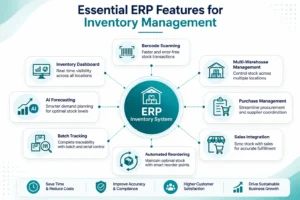
Look for solutions that include:
Inventory Dashboards
Real-time insights into stock levels, inventory value, and movement trends.
Barcode and RFID Integration
Improve inventory accuracy while reducing manual effort.
Multi-Warehouse Management
Track inventory across multiple locations with centralized visibility.
Purchase Management
Automate procurement while maintaining optimal inventory levels.
Sales Integration
Connect customer orders directly with inventory availability.
Automated Reorder Points
Prevent stock shortages through intelligent replenishment.
Batch and Serial Number Tracking
Improve traceability and compliance.
AI-Powered Forecasting
Use historical data and predictive analytics to improve purchasing decisions.
These are the core capabilities every trading business should evaluate before investing in an ERP solution. For a detailed explanation of each feature, implementation considerations, and how they benefit trading and distribution companies, read our comprehensive guide on essential ERP features for trading companies.
Inventory Management Best Practices
Technology alone isn’t enough. Businesses should also follow proven inventory management practices.
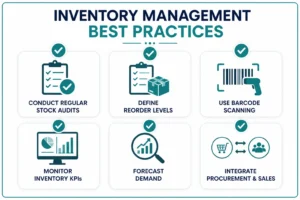
Conduct Regular Stock Audits
Routine cycle counts help maintain inventory accuracy.
Define Reorder Levels
Set minimum and maximum stock thresholds for every product.
Use Barcode Scanning
Reduce manual errors while speeding up warehouse operations.
Monitor Inventory KPIs
Track metrics such as:
- Inventory turnover
- Order fulfillment rate
- Carrying costs
- Stock accuracy
Forecast Demand Regularly
Update purchasing plans using current sales trends and market conditions.
Integrate Procurement and Sales
Connected processes reduce delays and improve inventory planning.
Why Trading Businesses in Bahrain Need Smarter Inventory Management
Businesses in Bahrain operate in a highly competitive and fast-moving market.
Trading companies often manage:
- Multiple warehouses
- Import and export operations
- GCC-wide distribution
- Large supplier networks
- Diverse product catalogs
Customer expectations have also changed. Buyers expect faster deliveries, accurate stock availability, and seamless order fulfillment.
At the same time, Bahrain’s digital transformation initiatives are encouraging businesses to modernize operations through cloud technologies.
A cloud ERP Bahrain solution allows businesses to:
- Access inventory securely from anywhere
- Scale operations without major infrastructure investments
- Improve collaboration between branches
- Support business growth across the GCC
For companies looking to remain competitive, investing in ERP is becoming less of an option and more of a necessity.
Better Inventory Starts with Better Systems
Many inventory problems aren’t caused by inventory itself. They’re caused by disconnected systems, manual processes, and limited visibility.
Businesses that implement integrated ERP solutions gain:
- Better inventory accuracy
- Faster decision-making
- Improved warehouse productivity
- Reduced operating costs
- Stronger customer satisfaction
- Greater scalability
By replacing isolated systems with a centralized ERP platform, businesses create a stronger foundation for long-term growth.
Take Control of Your Inventory with the Right ERP Solution
If your business is struggling with stock inaccuracies, warehouse inefficiencies, disconnected systems, or manual inventory processes, now is the time to modernize.
Webtree delivers scalable ERP solutions that provide complete inventory visibility, streamline procurement and warehouse operations, and empower businesses across Bahrain and the GCC to make faster, data-driven decisions. With the right ERP in place, better inventory management becomes the foundation for long-term operational excellence and growth.
How Webtree Can Help
At Webtree, we help businesses simplify complex inventory operations through intelligent ERP solutions tailored to their industry.
Our services include:
- ERP consulting and implementation
- Inventory management solutions
- Warehouse management systems
- Custom ERP development
- AI-powered inventory forecasting
- Business process automation
- Cloud ERP implementation
- Ongoing support, optimization, and training
Whether you’re a growing trading company, wholesale distributor, or import-export business, our team helps you implement ERP systems that improve inventory visibility, automate workflows, and support sustainable business growth.
Frequently Asked Questions
What are the biggest inventory management challenges?
The most common challenges include poor stock visibility, overstocking, stock shortages, inaccurate forecasting, manual data entry, warehouse inefficiencies, and limited inventory traceability.
How does ERP improve inventory management?
ERP centralizes inventory data, automates stock updates, integrates purchasing and sales, provides real-time reporting, and improves inventory accuracy across the organization.
Can ERP reduce inventory costs?
Yes. ERP helps optimize stock levels, reduce excess inventory, minimize stock shortages, improve purchasing decisions, and lower storage costs.
Is ERP suitable for businesses with multiple warehouses?
Absolutely. Modern ERP systems support multi-location inventory management, allowing businesses to monitor stock across all warehouses in real time.
Can ERP integrate with barcode scanners?
Yes. Most modern ERP platforms support barcode and RFID technologies, enabling faster, more accurate inventory tracking.