Key Takeaways
Proper conversion tracking is essential to measure ROI and optimize campaigns based on real business outcomes, not just clicks.
Negative keywords help eliminate irrelevant traffic, reducing wasted ad spend and improving lead quality.
Choosing the right keyword match types and regularly reviewing search terms ensures your ads reach users with genuine purchase intent.
Dedicated landing pages outperform generic homepages by providing a better user experience, improving Quality Score, and increasing conversions.
Customer-focused ad copy generates better results by highlighting benefits and solutions rather than simply promoting your business.
Continuous optimization is key to long-term success, including regular bid adjustments, ad testing, audience refinement, and performance monitoring.
A strategic, data-driven Google Ads management approach delivers higher-quality leads and better ROI than simply increasing your advertising budget.
Google Ads remains one of the fastest ways to generate qualified leads, but success depends on more than simply launching a campaign. Even businesses with healthy advertising budgets often struggle to achieve consistent results because of avoidable campaign mistakes.
Many advertisers celebrate high click volumes, only to realize those clicks are not translating into enquiries, sales, or revenue. Rising competition and increasing cost per click (CPC) mean that inefficient campaigns become expensive very quickly.
Small issues like poor keyword targeting, missing conversion tracking, or weak landing pages can quietly drain advertising budgets over time.
Understanding the most common Google Ads mistakes can help you improve campaign performance, reduce wasted spend, and generate higher-quality leads.
This guide explains the mistakes businesses frequently make and offers practical Google Ads optimization tips to help you maximize your return on investment.
Quick Checklist – Are You Making These Google Ads Mistakes?
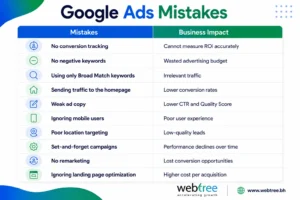
Why Google Ads Campaigns Fail?
Google Ads has become increasingly competitive across industries. Businesses are competing for valuable search terms, and CPCs continue to rise in sectors such as healthcare, construction, software, legal services, and home improvement.
As competition increases, every element of a campaign becomes more important. Poor targeting, irrelevant keywords, weak landing pages, or missing tracking can compound over time, increasing cost per lead while reducing conversions. Successful Google Ads management is not about spending more. It is about making smarter, data-driven decisions through continuous monitoring, testing, and optimization.
1. Not Tracking Conversions Properly
One of the biggest Google Ads mistakes is measuring clicks instead of business outcomes.
A campaign generating thousands of clicks may still be unprofitable if visitors never become customers.
Many businesses fail to track:
- Contact form submissions
- Phone calls
- WhatsApp enquiries
- Demo requests
- Purchases
- Offline conversions from CRM systems
According to Google’s conversion tracking documentation, measuring meaningful customer actions such as purchases, form submissions, and phone calls allows advertisers to understand which campaigns are driving real business outcomes rather than just clicks.
Best Practice
Track every meaningful customer action rather than relying solely on clicks or impressions. This allows you to optimize campaigns based on actual business results instead of vanity metrics.
2. Ignoring Negative Keywords
Negative keywords prevent your ads from appearing for irrelevant searches.
Without them, your ads may show for searches such as:
- Free
- Jobs
- Internship
- Course
- Tutorial
- DIY
These users are unlikely to become customers, yet every click consumes part of your advertising budget.
Adding negative keywords improves:
- Lead quality
- Click-through rate (CTR)
- Conversion rate
- Budget efficiency
Google recommends reviewing your Search Terms Report regularly to identify the actual search queries triggering your ads. This helps uncover irrelevant searches that can be added as negative keywords to reduce wasted ad spend.
3. Using Broad Match for Every Keyword
Broad Match keywords can help discover new search opportunities, but relying on them exclusively often attracts irrelevant traffic.
Understanding keyword match types is essential:
- Broad Match: Maximum reach but less control.
- Phrase Match: Better balance between reach and relevance.
- Exact Match: Highest intent with greater precision.
For most service businesses, Phrase Match works well for capturing qualified searches, while Exact Match is ideal for high-intent commercial keywords.
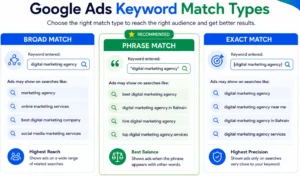
Regularly reviewing your Search Terms Report ensures your ads continue reaching the right audience.
4. Sending Traffic to the Homepage Instead of a Landing Page
Imagine a user searching for: Google Ads Agency Bahrain
They click your ad but land on a generic homepage that discusses every service your company offers.
Instead of finding the information they expected, they leave within seconds. Dedicated landing pages create a stronger message match between the user’s search and your content.
An effective landing page should include:
- A clear headline
- Relevant service information
- Strong call-to-action
- Trust signals
- Simple enquiry forms
Better landing pages typically improve Quality Score, increase conversions, and reduce cost per acquisition.
5. Writing Ads That Talk About You Instead of the Customer
Many businesses focus their advertisements on themselves.
Examples include:
- We are the best digital marketing agency.
- 15 years of experience.
While credibility matters, customers are primarily interested in solving their own problems.
Instead, write benefit-focused ads.
Examples:
- Generate More Qualified Leads
- Reduce Your Cost Per Acquisition
- Get a Free Google Ads Consultation
Effective ads answer one simple question: “What’s in it for me?”
6. Ignoring Mobile Optimization
Most Google searches now happen on mobile devices. If your landing page loads slowly or forms are difficult to complete on a smartphone, potential customers are likely to leave before converting.
Mobile-friendly campaigns should include:
- Fast-loading pages
- Click-to-call buttons
- WhatsApp CTAs
- Short enquiry forms
- Responsive layouts
A seamless mobile experience directly impacts conversion rates and Quality Score.
7. Poor Location Targeting
Showing ads outside your service area wastes valuable budget. Local businesses should focus on reaching users in the cities and regions they actually serve.
Effective location targeting offers several benefits:
- Better lead quality
- Lower cost per acquisition
- Improved conversion rates
- More efficient budget allocation
Businesses operating in multiple regions should create separate campaigns with localized messaging rather than using one campaign for every location.
8. Running Campaigns Without Ongoing Optimization
Google Ads is not a “set it and forget it” platform.
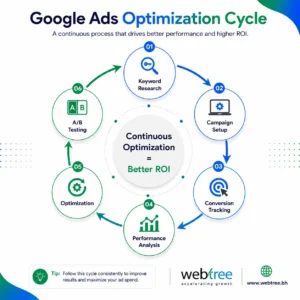
Campaign performance changes continuously as competitors adjust bids, customer behaviour shifts, and search trends evolve.
Regular optimization should include:
- Weekly Search Terms Report reviews
- Bid adjustments
- Ad copy testing
- Landing page improvements
- Device performance analysis
- Budget allocation reviews
Continuous optimization helps maintain strong ROI while preventing performance decline.
9. Ignoring Audience Targeting and Remarketing
Most visitors do not convert during their first website visit. Remarketing allows businesses to reconnect with previous visitors through relevant advertisements.
Benefits include:
- Higher conversion rates
- Better return on ad spend (ROAS)
- Increased brand recall
- Improved customer trust
Combining Google Ads with Meta Ads remarketing can create multiple touchpoints that guide prospects through the buying journey.
10. Focusing Only on Clicks Instead of ROI
High click volumes may look impressive, but they do not necessarily indicate campaign success. A campaign with fewer clicks but more qualified leads often delivers far greater business value than one generating thousands of low-quality visits.
Instead of focusing only on metrics like impressions and CTR, prioritize:
- Cost per lead
- Conversion rate
- Return on ad spend
- Customer acquisition cost
- Revenue generated
Measuring business outcomes helps you make informed optimization decisions and maximize long-term ROI.
Google Ads Best Practices for Businesses
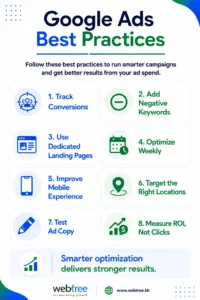
While every business has unique goals, a few proven practices consistently improve campaign performance.
For B2B Companies
- Target high-intent keywords
- Track phone calls and form submissions
- Optimize dedicated landing pages
For Retail Businesses
- Use precise location targeting
- Promote seasonal offers
- Prioritize mobile optimization
For Service Businesses
- Enable call extensions
- Add WhatsApp call-to-actions
- Target city-specific keywords
- Continuously refine negative keywords
Following these Google Ads best practices helps improve lead quality while reducing wasted spend.
Real Results Come From Strategy, Not Bigger Budgets
Many businesses assume that increasing their advertising budget will automatically generate more leads. In reality, campaign structure, targeting, landing page quality, and ongoing optimization have a much greater influence on long-term performance.
At Webtree, we focus on improving lead quality through data-driven optimization rather than simply increasing ad spend. Every campaign is refined using performance insights to help businesses achieve stronger ROI and sustainable growth.
Learn how strategic digital marketing helped a manufacturing business strengthen its online presence by exploring our Manufacturing Digital Marketing – Dubai case study.
How Webtree Helps Businesses Maximize Google Ads ROI
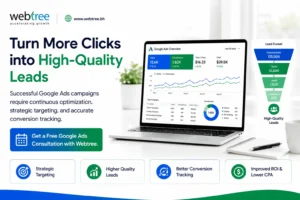
Successful Google Ads campaigns require more than simply creating advertisements. They require strategic planning, continuous optimization, and accurate performance measurement.
Webtree develops performance-driven Google Ads strategies tailored to each business’s objectives, industry, and target audience.
Our Google Ads management services include:
- Google Ads campaign setup and management
- Keyword research and competitor analysis
- Landing page recommendations
- Conversion tracking implementation
- Remarketing campaign strategies
- Performance reporting and analytics
- Ongoing campaign optimization
- Integrated Google Ads and Meta Ads strategies
Whether you are launching your first campaign or improving an existing one, our team helps you generate qualified leads through smarter targeting, better optimization, and data-driven decision-making.
If your Google Ads campaigns are generating clicks but not conversions, it’s time to rethink your strategy. Webtree helps businesses maximize advertising ROI through targeted campaign management, continuous optimization, and measurable performance improvements.
Frequently Asked Questions
Why do Google Ads campaigns fail?
Most campaigns fail because of poor keyword targeting, missing conversion tracking, weak landing pages, ineffective ad copy, and a lack of ongoing optimization.
What is the biggest Google Ads mistake?
Failing to track conversions is one of the most costly mistakes because it prevents businesses from identifying which campaigns actually generate leads and sales.
How often should Google Ads campaigns be optimized?
Campaigns should be reviewed at least weekly. Regular updates to keywords, bids, ad copy, landing pages, and negative keywords help maintain strong performance.
Is Google Ads better than social media advertising?
Google Ads captures users who are actively searching for products or services, making it highly effective for lead generation. Social media advertising is generally more effective for building awareness, engaging audiences, and supporting remarketing efforts.