Key Highlights
- AI improves inventory forecasting by analyzing real-time business data.
- Predictive demand forecasting reduces stockouts and overstocking.
- Dynamic safety stock helps maintain optimal inventory levels.
- AI automates replenishment based on demand and supplier lead times.
- Multi-warehouse inventory optimization improves stock distribution.
- AI forecasting strengthens cash flow through better inventory control.
- ERP integration enables end-to-end inventory visibility.
- Distribution businesses gain faster, data-driven decision making.
- Bahrain and GCC distributors can improve supply chain resilience with AI.
- Webtree delivers AI-powered ERP and inventory forecasting solutions tailored to business needs.
Inventory forecasting has always been one of the biggest challenges for distribution businesses. Ordering too much inventory ties up working capital and increases storage costs, while ordering too little results in stockouts, delayed deliveries, and dissatisfied customers.
Many businesses still depend on spreadsheets, fixed reorder points, and historical averages to predict future demand. While these methods may have worked in relatively stable markets, today’s supply chains are far more dynamic. Changing customer preferences, seasonal fluctuations, supplier delays, and global disruptions require a smarter approach.
This is where AI for inventory forecasting in distribution businesses is making a significant impact. By combining machine learning, predictive analytics, and real-time business data, AI helps companies forecast demand more accurately, automate replenishment, optimize inventory levels, and improve customer satisfaction.
For distribution businesses in Bahrain and across the GCC, adopting AI-powered inventory forecasting is becoming an essential step toward digital transformation.
What Is AI Inventory Forecasting?
AI inventory forecasting uses artificial intelligence, machine learning, and predictive analytics to estimate future inventory demand with greater accuracy than traditional methods.
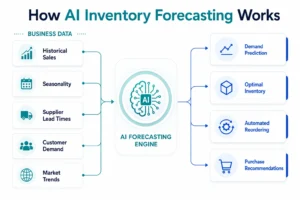
Unlike conventional forecasting, which relies mainly on historical sales, AI continuously learns from multiple sources of data, including:
- Historical sales trends
- Seasonal demand
- Customer purchasing behavior
- Supplier lead times
- Promotions and marketing campaigns
- Market trends
- Inventory movement across warehouses
Instead of producing static forecasts, AI continuously updates predictions as new information becomes available, allowing businesses to respond quickly to changing market conditions.
Deloitte notes that AI-powered inventory optimization enables organizations to improve demand forecasting, automate replenishment decisions, optimize inventory levels, and perform scenario planning using real-time business data, helping businesses respond more effectively to changing market conditions.
Why Traditional Inventory Forecasting Falls Short
Traditional inventory planning often creates more problems than solutions.
Some common challenges include:
Spreadsheet Dependency
Manual spreadsheets are difficult to maintain, prone to errors, and rarely provide real-time visibility.
Static Reorder Levels
Fixed reorder points fail to adjust when customer demand changes unexpectedly.
Manual Calculations
Forecasts based on human assumptions often overlook multiple influencing factors.
Seasonal Fluctuations
Conventional methods struggle to anticipate seasonal demand spikes or sudden market changes.
Supply Chain Disruptions
Supplier delays and transportation issues require dynamic forecasting that spreadsheets simply cannot provide.
Human Error
Manual inventory planning increases the likelihood of inaccurate forecasts, duplicate orders, and stock shortages.
How AI Improves Inventory Forecasting
Predicting Customer Demand
AI demand forecasting analyzes far more variables than traditional forecasting.
It considers:
- Historical sales
- Customer buying behavior
- Seasonal trends
- Regional demand
- Promotional campaigns
- External market conditions
This enables businesses to anticipate future demand instead of simply reacting to it.
Dynamic Safety Stock Management
Maintaining the right safety stock is essential.
AI automatically adjusts safety stock levels based on:
- Demand variability
- Supplier reliability
- Lead time fluctuations
- Sales velocity
The result is fewer stockouts while minimizing excess inventory.
Automated Inventory Replenishment
Rather than relying on manual purchasing decisions, AI generates intelligent replenishment recommendations.
It can:
- Recommend purchase quantities
- Trigger automatic reorder alerts
- Optimize purchase timing
- Consider supplier lead times
- Reduce emergency purchasing
This helps procurement teams operate more efficiently.
Multi-Warehouse Inventory Optimization
Distribution companies often operate multiple warehouses.
AI helps optimize inventory by:
- Forecasting demand for each location
- Balancing inventory between warehouses
- Reducing unnecessary transfers
- Improving SKU availability
- Supporting location-specific replenishment
This ensures inventory is available where customers actually need it.
Working Capital Optimization
One of the biggest benefits of AI inventory forecasting is improved cash flow.
AI identifies:
- Slow-moving inventory
- Overstocked products
- Fast-moving SKUs
- Inventory turnover trends
Businesses can reduce unnecessary inventory investments while maintaining high service levels.
Traditional Inventory Forecasting vs AI Forecasting
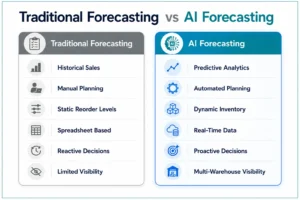 The difference is simple. Traditional forecasting reacts to yesterday’s data, while AI prepares businesses for tomorrow’s demand.
AI-powered inventory forecasting delivers the greatest business value when it’s part of a broader digital transformation strategy. By combining AI with ERP, cloud technologies, automation, and real-time analytics, trading and distribution businesses can create connected, data-driven operations that support long-term growth. Explore our guide to digital transformation for trading companies to learn how these technologies work together.
Key Features of AI-Powered Inventory Forecasting
Modern inventory forecasting software offers a wide range of intelligent capabilities.
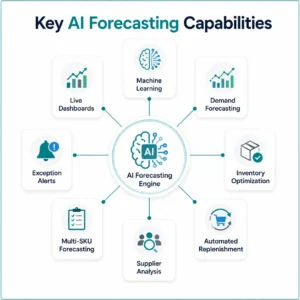
These include:
Machine Learning
Forecast accuracy improves continuously as the system learns from new data.
AI Demand Forecasting
Predicts future demand using multiple business variables rather than historical sales alone.
Inventory Optimization
Maintains optimal stock levels while reducing carrying costs.
Automated Replenishment
Automatically recommends purchasing decisions based on inventory status.
Supplier Lead Time Analysis
Considers supplier performance when generating forecasts.
Multi-SKU Forecasting
Forecasts demand across thousands of products simultaneously.
Exception Alerts
Notifies users about unusual demand patterns or potential shortages.
Interactive Dashboards
Provides real-time visibility into inventory performance through business intelligence reports.
Accurate demand forecasting is only one part of effective inventory management. Businesses also need streamlined procurement, stock control, and real-time inventory visibility to turn forecasts into actionable decisions. Learn how to overcome these operational hurdles in our guide to inventory management challenges and ERP solutions.
Business Benefits for Distribution Companies
Implementing AI inventory forecasting produces measurable business outcomes.
Lower Inventory Costs
Businesses carry only the inventory they actually need.
Reduced Stockouts
Accurate forecasting improves product availability.
Better Customer Service
Customers receive products on time, increasing satisfaction and loyalty.
Faster Inventory Turnover
AI reduces slow-moving inventory and improves stock movement.
Improved Procurement Planning
Purchasing teams make better decisions using predictive insights.
Higher Operational Efficiency
Automation reduces manual work and improves productivity.
Better Cash Flow
Lower inventory investments free working capital for business growth.
AI + ERP: A Powerful Combination
AI is most effective when integrated with an ERP system.
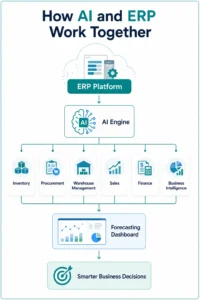
Rather than replacing ERP software, AI enhances it by making inventory decisions smarter and faster.
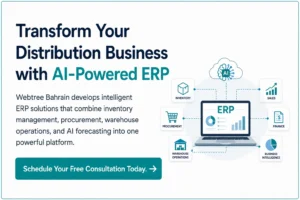
An AI-enabled ERP connects information from:
- Inventory management
- Procurement
- Sales
- Warehouse management
- Finance
- Business intelligence
This creates a unified view of operations, allowing AI to generate highly accurate forecasts.
Most modern AI forecasting solutions integrate with existing ERP platforms through APIs, allowing businesses to upgrade their forecasting capabilities without replacing their entire system.
Common Mistakes to Avoid When Implementing AI For Inventory Forecasting
Successful AI adoption requires more than installing software.
Avoid these common mistakes:
Poor Data Quality
AI depends on accurate inventory, sales, and supplier data.
Unrealistic Expectations
AI improves forecasting but still requires business oversight.
Ignoring Employee Training
Employees need proper training to understand AI recommendations.
No ERP Integration
Standalone AI solutions often create disconnected workflows.
Lack of Continuous Monitoring
AI models should be reviewed and optimized regularly to maintain forecasting accuracy.
AI Inventory Forecasting for Distribution Businesses in Bahrain
Bahrain is becoming an increasingly important logistics and distribution hub within the GCC.
Distribution businesses today manage:
- Multiple warehouses
- Regional supply chains
- International imports
- Cross-border exports
- Diverse customer demand
These complexities make manual forecasting increasingly difficult.
AI helps Bahrain-based businesses respond to market changes faster while improving inventory visibility across the entire supply chain.
As digital transformation accelerates across the GCC, AI-powered predictive inventory management is becoming a competitive advantage rather than a future investment.
From Reactive Inventory Management to Predictive Planning
Modern distribution businesses require more than inventory visibility. They need predictive insights that support faster and smarter decision-making.
Imagine a distributor managing thousands of SKUs across several warehouses. Traditional forecasting identifies shortages only after they occur. An AI-powered ERP system continuously analyzes demand patterns, supplier performance, inventory levels, and warehouse movements.
It recommends replenishment before shortages occur, balances stock across locations, and identifies slow-moving products before they affect profitability.
The result is a more responsive supply chain, improved customer service, and healthier cash flow.
How Webtree Can Help
As customer expectations grow and supply chains become more complex, traditional forecasting methods are no longer enough. AI for inventory forecasting in distribution businesses empowers organizations to make faster, smarter, and more accurate inventory decisions by combining predictive analytics with real-time operational data.
At Webtree Bahrain, we help distribution, wholesale, and trading businesses embrace intelligent digital transformation through AI-powered business solutions.
Our expertise includes:
- AI-powered ERP implementation
- Inventory forecasting solutions
- Custom AI application development
- Inventory and warehouse management systems
- Predictive business intelligence dashboards
- Cloud ERP integration
- Process automation
- Ongoing optimization and technical support
Whether you’re looking to improve inventory accuracy, automate procurement, or gain better visibility across your supply chain, our solutions are designed to help your business operate more efficiently while preparing for future growth.
Frequently Asked Questions
What is AI inventory forecasting?
AI inventory forecasting uses machine learning and predictive analytics to analyze sales history, demand trends, supplier lead times, and other business data to improve inventory planning and forecasting accuracy.
How does AI reduce stockouts?
AI predicts future demand more accurately and recommends replenishment before inventory reaches critical levels, helping businesses maintain product availability.
Can AI forecasting work with existing ERP systems?
Yes. Most AI forecasting solutions integrate with ERP systems using APIs, enabling businesses to enhance forecasting without replacing their existing ERP software.
Is AI inventory forecasting suitable for small businesses?
Absolutely. Many cloud-based inventory forecasting software solutions are scalable and affordable, making them suitable for SMEs as well as large enterprises.
Which industries benefit most from AI inventory forecasting?
Distribution, wholesale, retail, manufacturing, healthcare, eCommerce, and logistics businesses all benefit from AI-powered inventory optimization and predictive demand forecasting.