Key Takeaways
- An ERP system centralizes inventory, procurement, sales, finance, and logistics into one integrated platform.
- Real time inventory management helps reduce stock shortages, excess inventory, and manual errors.
- Cloud ERP enables secure access from anywhere, making it ideal for multi branch and GCC based trading businesses.
- AI powered ERP enhances forecasting, reporting, inventory planning, and workflow automation to support better decision making.
- Choosing an ERP with strong customization, integration capabilities, and local implementation support is essential for long term success.
- Successful ERP implementation depends on careful planning, clean data migration, employee training, and continuous optimization.
- For trading companies in Bahrain, ERP supports VAT compliance, regional expansion, operational efficiency, and long term digital transformation.
Trading companies operate in a fast moving environment where inventory, procurement, finance, warehousing, and customer management must work together seamlessly. As businesses grow, managing these operations through spreadsheets or disconnected software becomes increasingly difficult. Delays in order processing, inaccurate inventory records, manual accounting, and poor visibility into business performance can quickly affect profitability and customer satisfaction.
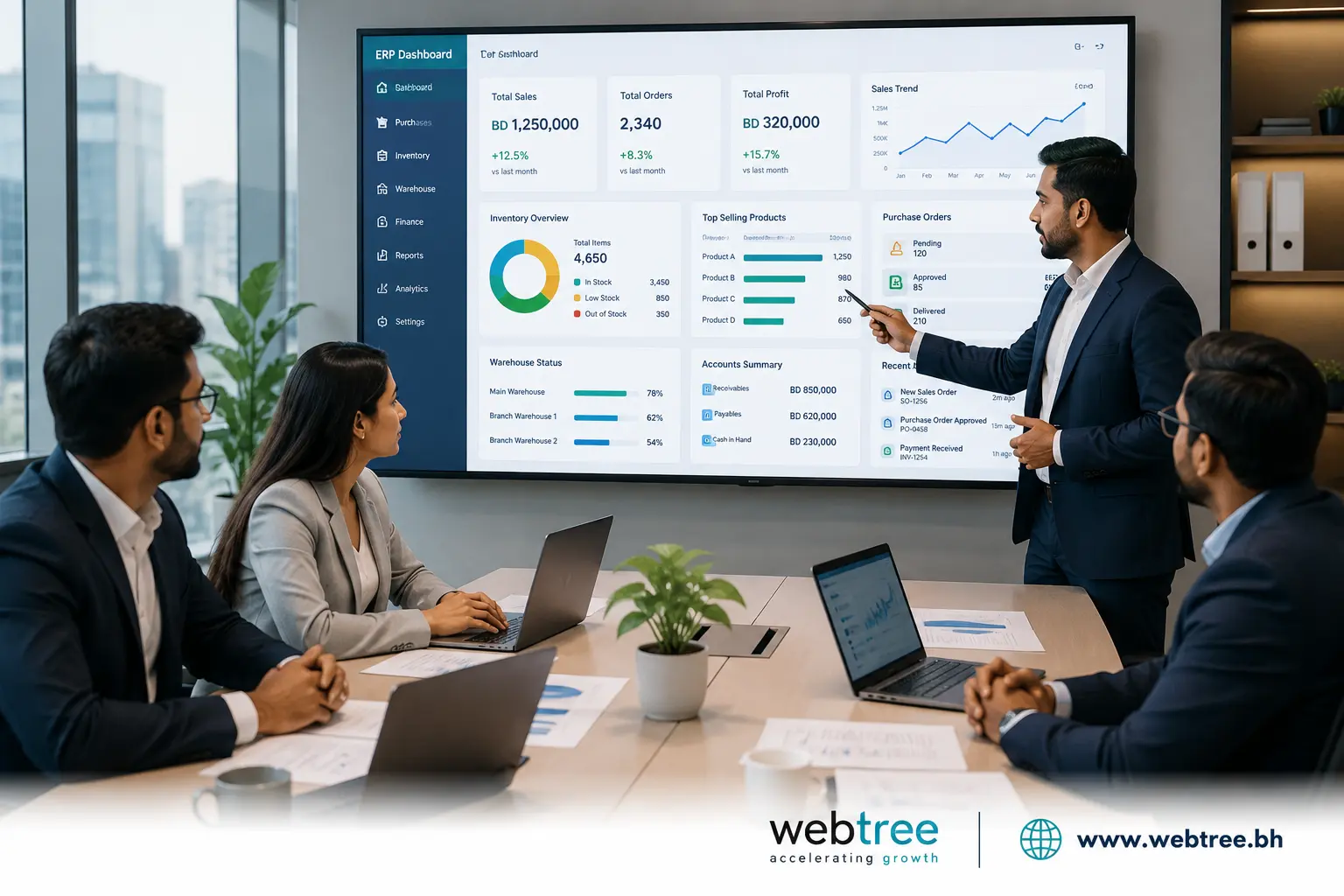
This is where ERP for trading companies becomes essential. An Enterprise Resource Planning (ERP) system connects every core business function into a single platform, allowing teams to work with accurate, real time information. Instead of switching between multiple systems, businesses can manage purchasing, inventory, sales, finance, logistics, and reporting from one centralized dashboard.
For trading companies in Bahrain and across the GCC, adopting the right ERP solution is becoming an important step toward improving operational efficiency, supporting regional expansion, and meeting growing customer expectations.
In this guide, we’ll explore the ERP features that matter most and how choosing the right solution can help your business grow.
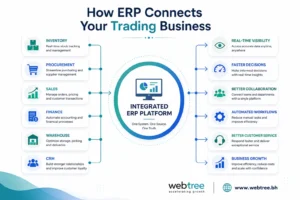
Why Trading Companies Need an ERP System
Many trading businesses begin with separate tools for accounting, inventory, sales, and procurement. While this approach may work initially, it often creates operational challenges as the business expands.
Some of the most common issues include:
- Inventory inaccuracies due to manual stock updates
- Duplicate data entry across different systems
- Slow financial reporting
- Limited visibility into stock across multiple warehouses
- Delays in procurement and supplier approvals
- Poor coordination between departments
A modern ERP software for trading companies eliminates these problems by integrating every business process. Since all departments work from the same database, information is updated instantly, reducing errors and improving decision making.
Whether you’re managing wholesale distribution, imports and exports, or multi branch trading operations, a trading ERP system helps streamline daily operations while preparing your business for long term growth.
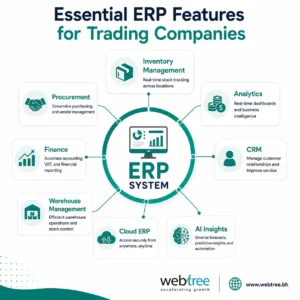
Essential ERP Features Every Trading Company Should Have
Choosing an ERP is not simply about replacing existing software. The right solution should support the unique operational needs of trading businesses while remaining flexible enough to grow alongside your organization.
Real Time Inventory Management
Inventory is the backbone of every trading business. Without accurate stock information, businesses risk overstocking, stock shortages, delayed deliveries, and lost sales.
A modern inventory management ERP should include:
- Real time stock tracking
- Multi warehouse inventory management
- Batch and serial number tracking
- Automated stock replenishment
- Barcode integration
- Inventory valuation reports
With complete visibility into inventory across multiple locations, businesses can make faster purchasing decisions and reduce unnecessary inventory costs.
Procurement and Vendor Management
Efficient procurement directly impacts profitability. ERP systems simplify purchasing by automating procurement workflows and improving supplier management.
Key capabilities include:
- Purchase requisitions
- Purchase order management
- Supplier performance tracking
- Vendor pricing comparison
- Approval workflows
- Purchase history
Having centralized procurement data helps businesses negotiate better supplier contracts while reducing purchasing delays.
Sales and Order Management
Trading companies handle multiple customer orders every day. Managing quotations, invoices, deliveries, and payments manually often results in processing errors.
A good ERP should support:
- Sales quotations
- Order processing
- Invoice generation
- Delivery scheduling
- Credit limit management
- Order status tracking
By automating the entire sales cycle, businesses can process orders faster while improving customer satisfaction.
Accounting and Financial Management
Finance teams need accurate information to monitor cash flow, profitability, and compliance.
Essential accounting features include:
- General ledger
- Accounts payable
- Accounts receivable
- Bank reconciliation
- VAT reporting
- Financial statements
- Budget management
- Real time financial dashboards
Since all transactions flow automatically into the accounting module, businesses reduce manual data entry and improve financial accuracy.
Warehouse and Logistics Management
Warehouse operations become increasingly complex as businesses expand across multiple locations.
ERP systems improve logistics through:
- Warehouse transfers
- Picking and packing management
- Shipment tracking
- Dispatch planning
- Delivery monitoring
- Warehouse performance reporting
This ensures products move efficiently from suppliers to customers with fewer delays.
CRM Integration
Customer relationships are just as important as inventory management.
Modern ERP solutions integrate Customer Relationship Management (CRM) capabilities that provide:
- Customer profiles
- Purchase history
- Credit management
- Sales follow ups
- Communication history
- Customer segmentation
Sales teams gain a complete view of every customer, allowing them to deliver better service and improve retention.
Reporting and Business Intelligence
Business decisions should be based on real time information instead of assumptions.
Advanced reporting tools provide insights into:
- Sales performance
- Inventory movement
- Procurement trends
- Customer profitability
- Financial performance
- Operational KPIs
Interactive dashboards allow business leaders to identify opportunities and respond quickly to changing market conditions.
Cloud Accessibility
Many trading companies now operate across multiple cities or GCC countries. Teams often require secure access while working remotely or travelling.
A cloud ERP for trading companies offers:
- Secure access from anywhere
- Multi branch collaboration
- Automatic software updates
- Reduced IT infrastructure costs
- Data backup and disaster recovery
- Scalable deployment
Cloud ERP enables businesses to operate efficiently without maintaining expensive on premises servers.
ERP Features at a Glance
| ERP Feature | Business Benefit |
|---|
| Inventory Management | Prevent stock shortages and improve stock accuracy |
| Procurement | Faster purchasing and supplier management |
| Accounting | Accurate financial reporting and VAT compliance |
| CRM | Better customer relationships and sales visibility |
| Warehouse Management | Faster order fulfillment and logistics control |
| Analytics | Smarter business decisions through real-time insights |
| Cloud ERP | Secure access from anywhere |
| AI Insights | Better forecasting and operational planning |

AI Powered ERP: The Next Step for Trading Companies
Artificial intelligence is gradually becoming an important enhancement within modern ERP systems. Rather than replacing human decision making, AI helps businesses analyze large volumes of operational data more efficiently.
Some of the most valuable AI powered ERP capabilities include:
Demand Forecasting
AI analyzes historical sales patterns, seasonal demand, and purchasing behavior to help businesses estimate future inventory requirements.
Inventory Optimization
By identifying slow moving stock and predicting replenishment needs, AI supports more efficient inventory planning and helps reduce carrying costs.
Automated Reporting
Instead of manually compiling reports, AI can generate operational summaries and highlight unusual business trends for faster analysis.
Predictive Analytics
AI powered dashboards help businesses identify potential supply chain disruptions, purchasing risks, or changing customer demand before they become significant issues.
Workflow Automation
Routine tasks such as invoice approvals, purchase requests, notifications, and report generation can be automated, allowing employees to focus on higher value activities.
For trading companies, AI serves as a decision support tool that improves efficiency while providing deeper business insights.
Cloud ERP vs Traditional ERP
Choosing between cloud and on premises ERP depends on your business goals, IT infrastructure, and long term growth plans.
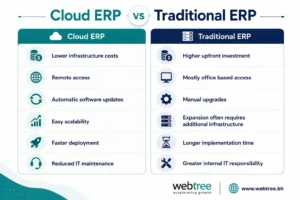
Many growing businesses now prefer cloud ERP because it offers greater flexibility and supports distributed teams across multiple locations.
How to Choose the Right ERP for Your Trading Business
Not every ERP system is designed for trading operations. Selecting the right solution requires evaluating both your current requirements and future business plans.
Consider the following factors:
Business Size
Choose a system that fits your current operations while allowing room for future expansion.
Industry Experience
Look for ERP providers with experience implementing solutions for wholesale, trading, import, and distribution businesses.
Customization
Every trading business has unique workflows. Your ERP should adapt to your business rather than forcing your team to change established processes.
Integration Capabilities
Modern ERP systems should integrate with CRM platforms, accounting software, eCommerce websites, payment gateways, warehouse systems, and business intelligence tools.
Local Support
Working with an implementation partner that understands Bahrain’s business environment ensures faster deployment and better ongoing support.
Scalability
As your business grows across Bahrain and the GCC, your ERP should easily support additional users, warehouses, products, and locations.
Implementation Partner
Technology alone does not guarantee success. An experienced ERP implementation partner helps map business processes, migrate data, train employees, and optimize the system after deployment.
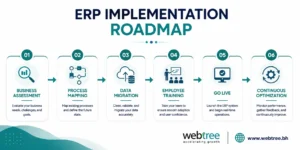
Choosing the right ERP is only part of the journey. Successful trading companies also align their ERP implementation with a clear digital transformation roadmap to improve collaboration, enhance customer experience, and support future growth. Read our guide on digital transformation for trading companies in Bahrain to learn more.
ERP Implementation Best Practices
Successful ERP implementation requires careful planning and collaboration across departments.
Some best practices include:
Analyze Existing Business Processes
Understand current workflows before configuring the ERP system. This helps eliminate inefficient processes instead of simply digitizing them.
Plan Data Migration Carefully
Clean, organized data leads to smoother implementation and more reliable reporting.
Train Employees
User adoption plays a major role in ERP success. Provide comprehensive training so employees feel confident using the new system.
Implement in Phases
Rather than deploying every module at once, many businesses achieve better results by implementing ERP gradually.
Continue Optimizing
ERP implementation is an ongoing process. Regular reviews help identify opportunities for further automation and operational improvements.
Why ERP Is Essential for Bahrain Trading Companies
Bahrain continues to strengthen its position as a regional business and logistics hub, making digital transformation increasingly important for trading companies.
Businesses operating across Bahrain and the GCC often manage:
- Multiple warehouse locations
- Regional suppliers
- Cross border trading operations
- VAT compliance requirements
- Growing customer expectations
- Expanding product portfolios
A modern ERP solution businesses can rely on provides centralized visibility across every location while supporting regulatory compliance and operational efficiency.
Cloud adoption is also accelerating across the region, enabling businesses to modernize operations without investing heavily in IT infrastructure. Companies that invest in integrated ERP systems are better positioned to respond quickly to changing market conditions and support long term growth.
From Business Challenges to Smarter Operations
Successful ERP implementation is not just about installing software. It is about improving business processes, increasing operational visibility, and enabling sustainable growth.
Organizations that invest in the right ERP solution often experience:
- Better inventory accuracy
- Faster procurement cycles
- Improved financial reporting
- Higher customer satisfaction
- Greater operational transparency
- Stronger collaboration between departments
Explore how Webtree helps businesses modernize operations through digital transformation and integrated technology solutions, including manufacturing and enterprise process optimization.
How Webtree Can Help
At Webtree, we help businesses move beyond disconnected systems and manual processes by delivering ERP solutions tailored to their operational needs.
Our services include:
- ERP consulting and business process analysis
- Custom ERP development
- Cloud ERP implementation
- Business process automation
- AI powered reporting and analytics
- ERP integration with CRM, eCommerce platforms, and third party applications
- Ongoing support, optimization, and user training
Whether you’re a growing wholesale distributor, importer, exporter, or multi branch trading company, our team works closely with you to implement an ERP solution that supports long term business growth.
Transform Your Trading Operations with the Right ERP Solution
The right ERP system gives trading companies the visibility, automation, and control needed to compete in today’s dynamic business environment. From inventory management and procurement to finance, logistics, and AI powered reporting, an integrated ERP platform enables faster decisions and more efficient operations.
If your business is ready to improve productivity, reduce operational complexity, and scale confidently across Bahrain and the GCC, Webtree can help you implement an ERP solution designed around your business goals.
Frequently Asked Questions
What is ERP for trading companies?
ERP software helps trading companies manage inventory, procurement, sales, accounting, logistics, reporting, and customer information through one integrated platform.
Which ERP features are most important for trading businesses?
The most important features include inventory management, procurement, accounting, CRM, warehouse management, reporting, cloud accessibility, and integration capabilities.
Is cloud ERP better for trading companies?
For many businesses, cloud ERP offers greater flexibility, remote access, automatic updates, easier scalability, and lower infrastructure costs than traditional on premises systems.
Can ERP integrate with existing business systems?
Yes. Modern ERP platforms integrate with CRM software, accounting systems, eCommerce websites, payment gateways, warehouse applications, and other third party business tools.
How long does ERP implementation take?
Implementation timelines vary depending on business size, customization, data migration, and the number of modules being deployed. Most ERP projects are completed within several weeks to a few months.
Can an ERP system manage multiple warehouses?
Yes. Most modern ERP systems support multi-warehouse management, allowing businesses to track stock levels, transfers, and inventory movement across different locations in real time.
Is ERP suitable for small and medium-sized trading businesses?
Absolutely. Many cloud-based ERP solutions are designed for SMEs and can scale as the business grows, making them a cost-effective investment for both small and large trading companies.
What industries can benefit from ERP besides trading?
ERP solutions are widely used across manufacturing, wholesale distribution, retail, logistics, healthcare, construction, and service-based businesses to streamline operations and improve productivity.
How do I know when my trading business needs an ERP system?
If your business relies on spreadsheets, experiences inventory inaccuracies, manages multiple locations, or struggles with disconnected systems and delayed reporting, it’s a strong indication that an ERP solution can improve efficiency.