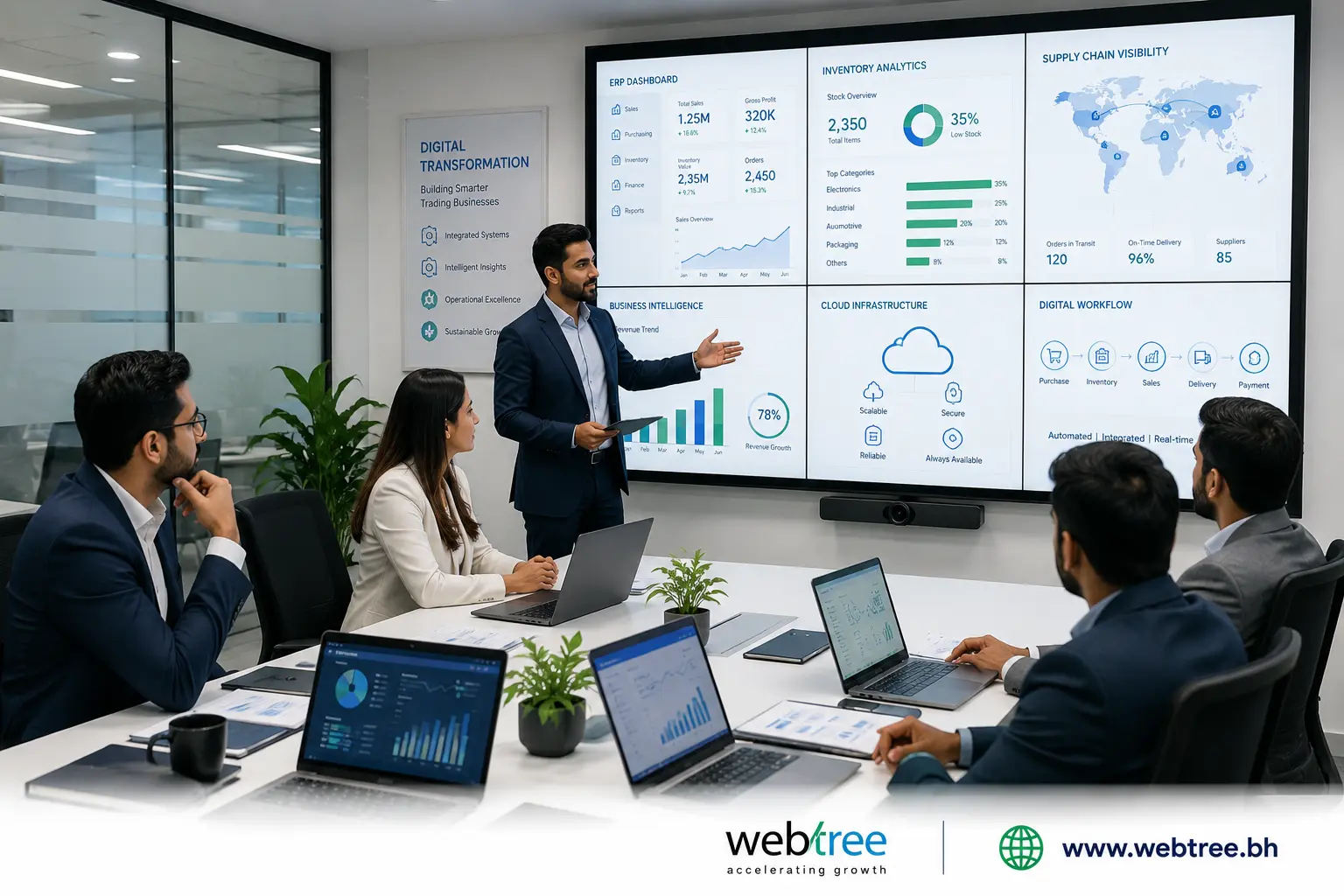
Key Highlights
- Digital transformation helps trading companies improve efficiency using ERP, AI, cloud computing, and automation.
- Bahrain’s digital economy, Cloud First policy, and growing customer expectations make digital transformation a business necessity.
- Common challenges include manual workflows, inventory errors, disconnected systems, delayed reporting, and limited supply chain visibility.
- Cloud ERP centralizes inventory, procurement, finance, sales, and reporting while providing real-time business insights.
- AI and Business Intelligence improve demand forecasting, inventory optimization, sales forecasting, and data-driven decision-making.
- Supply chain automation, IoT, and B2B customer portals streamline operations and enhance customer experiences.
- Digital transformation leads to faster operations, lower costs, improved productivity, better compliance, and greater scalability.
- Partnering with an experienced digital transformation provider ensures successful ERP implementation, AI integration, cloud adoption, and long-term business growth.
Trading companies are the backbone of Bahrain’s economy, connecting manufacturers, suppliers, wholesalers, retailers, and customers across local and international markets. However, as customer expectations evolve and supply chains become increasingly complex, relying on traditional business processes is no longer enough to remain competitive.
Businesses are expected to process orders faster, provide real-time inventory updates, manage multiple suppliers across borders, and deliver seamless customer experiences. These growing demands make it increasingly difficult for trading companies to scale using conventional systems alone.
This is where digital transformation for trading companies in Bahrain becomes a strategic advantage rather than simply a technology upgrade. By integrating Enterprise Resource Planning (ERP) systems, artificial intelligence (AI), cloud computing, supply chain automation, and intelligent business applications, trading companies can streamline operations, improve decision-making, reduce costs, and position themselves for long-term growth.
What Is Digital Transformation for Trading Companies?
Digital transformation refers to the integration of digital technologies into every aspect of a business to improve operational efficiency, customer experiences, and overall business performance. For trading companies, it involves replacing fragmented and manual processes with connected digital systems that provide real-time information across departments.
Rather than managing procurement, inventory, finance, sales, logistics, and customer service separately, digitally transformed businesses operate through integrated platforms that keep information synchronized throughout the organization.
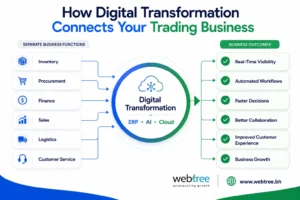
Some of the key technologies driving this transformation include:
Enterprise Resource Planning (ERP)
An ERP system acts as the central hub of a trading business by connecting multiple business functions into a single platform. Instead of using separate software for inventory, accounting, procurement, and sales, everything is managed through one integrated system.
Modern ERP for trading companies enables businesses to:
- Track inventory across multiple warehouses
- Manage procurement and supplier relationships
- Automate accounting and financial reporting
- Process customer orders efficiently
- Generate real-time business insights
- Improve compliance and audit readiness
With cloud-based ERP solutions, employees can securely access business data from anywhere, making operations more flexible and responsive.
Process Automation
Many trading companies spend significant time on repetitive administrative tasks such as:
- Creating purchase orders
- Processing invoices
- Approving supplier requests
- Updating inventory records
- Generating reports
- Managing shipping documentation
Automation eliminates these repetitive tasks by allowing predefined workflows to handle routine operations with minimal human intervention.
For example, once inventory falls below a specified threshold, the system can automatically generate a purchase request, notify the procurement team, and begin the supplier approval process without manual input.
This not only saves time but also minimizes human errors and accelerates business operations.
Artificial Intelligence (AI)
Artificial intelligence is becoming an essential component of B2B digital transformation. Rather than replacing employees, AI enhances decision-making by analyzing large volumes of business data and identifying patterns that would otherwise be difficult to detect.
AI-powered solutions can help trading companies:
- Forecast future product demand
- Predict seasonal buying patterns
- Recommend optimal inventory levels
- Detect unusual purchasing behavior
- Improve sales forecasting
- Automate routine customer inquiries
These insights enable businesses to make proactive decisions instead of reacting to problems after they occur. According to the KPMG Global Tech Report 2025, organizations continue to prioritize AI, cloud computing, and automation to improve operational efficiency, resilience, and long-term business growth.
Cloud Computing
Cloud technology allows businesses to move their software, databases, and applications from on-premise servers to secure cloud infrastructure.
For trading companies, adopting cloud ERP Bahrain solutions offers several advantages:
- Secure access from any location
- Lower IT infrastructure costs
- Automatic software updates
- Improved data backup and recovery
- Better collaboration across branches
- Enhanced scalability as the business grows
Cloud computing also simplifies expansion into new markets by enabling centralized management of operations across multiple locations.
Integrated Business Applications
Digital transformation is most effective when different business applications work together seamlessly.
For example:
- ERP integrates with accounting software
- Inventory systems connect with warehouse management
- CRM integrates with sales processes
- Procurement links with supplier portals
- Logistics systems connect with shipment tracking
Instead of departments operating independently, integrated applications ensure that everyone works from the same real-time data, reducing duplication and improving collaboration.
Why Bahrain Trading Companies Need Digital Transformation
Bahrain has established itself as one of the Gulf region’s leading business and logistics hubs. Its strategic location, business-friendly regulations, modern infrastructure, and access to regional markets make it an attractive destination for trading companies.
However, increased opportunities also bring increased competition. Customers now expect faster deliveries, greater transparency, and seamless digital interactions. Businesses that continue relying on manual systems may struggle to keep pace.
Here are some of the key reasons why digital transformation for trading companies in Bahrain has become essential.
Growing Regional Competition
Trading companies today compete not only with local businesses but also with regional and international suppliers.
Customers can compare prices, delivery timelines, and service quality within minutes. To remain competitive, businesses need digital systems that enable faster response times, accurate inventory visibility, and efficient order fulfillment.
Digital transformation allows companies to streamline operations while improving customer satisfaction.
Expanding Across GCC Markets
Many Bahrain-based trading companies serve customers throughout the GCC.
Managing suppliers, warehouses, and customers across multiple countries introduces challenges such as:
- Currency management
- Multi-location inventory
- Regional tax compliance
- Cross-border logistics
- International procurement
Integrated ERP systems simplify these complexities by providing centralized control over business operations regardless of location.
Rise of Digital Trade
Business buyers increasingly prefer digital purchasing experiences.
Instead of lengthy email exchanges and phone calls, customers now expect:
- Online product catalogs
- Self-service ordering
- Digital invoices
- Order tracking
- Instant quotations
Trading companies that invest in digital platforms can provide a more convenient buying experience while reducing administrative workloads.
Bahrain’s Cloud First Policy
Bahrain has taken significant steps toward becoming a regional leader in digital innovation through its Cloud First policy, encouraging government entities and businesses to adopt cloud technologies where appropriate.
This initiative has accelerated the adoption of cloud infrastructure, making digital transformation more accessible for businesses of all sizes.
For trading companies, cloud adoption means:
- Greater operational flexibility
- Improved cybersecurity
- Faster deployment of business applications
- Reduced infrastructure investments
Government Support for Digitalization
Bahrain continues to encourage digital adoption through various initiatives that support innovation, technology investment, and business modernization.
Organizations that embrace digital transformation can benefit from an ecosystem designed to foster technology-driven growth and economic diversification.
Increasing Customer Expectations
Today’s B2B customers expect the same convenience they experience as consumers.
They want:
- Faster order processing
- Accurate inventory information
- Digital documentation
- Personalized service
- Transparent communication
- Real-time shipment updates
Meeting these expectations requires integrated digital systems capable of delivering timely and accurate information.
Key Challenges Facing Trading Companies
Before beginning any digital transformation journey, it is important to understand the operational challenges that many trading businesses face. Identifying these bottlenecks helps organizations prioritize the right technologies and maximize their return on investment.
Manual Business Processes
Many trading companies continue to rely on spreadsheets, handwritten records, email approvals, and paper documentation.
These manual processes often result in:
- Duplicate data entry
- Slow approvals
- Increased administrative work
- Higher error rates
- Delayed decision-making
As businesses grow, these inefficiencies become increasingly difficult to manage.
Inventory Inaccuracies
Inventory management is one of the biggest operational challenges for trading companies.
Without real-time inventory visibility, businesses may experience:
- Overstocking
- Stock shortages
- Lost sales opportunities
- Excess storage costs
- Incorrect purchase planning
Modern inventory management systems provide accurate, real-time stock information that helps businesses optimize inventory levels and improve order fulfillment.
Disconnected Software Systems
Many organizations use separate applications for accounting, procurement, warehouse management, customer relationship management, and sales.
Because these systems do not communicate with each other, employees often need to enter the same information multiple times.
Disconnected software leads to:
- Data inconsistencies
- Reporting delays
- Communication gaps
- Reduced productivity
- Poor customer experiences
Integrated ERP solutions eliminate these silos by connecting business functions within a unified platform.
Delayed Reporting
Business leaders rely on accurate reports to make informed decisions.
When reports are generated manually, it may take days or even weeks to compile financial statements, sales reports, or inventory analyses.
By the time reports are available, the information may already be outdated.
Digital reporting dashboards provide real-time visibility into key business metrics, enabling faster and more informed decision-making.
Lack of Real-Time Supply Chain Visibility
Trading companies often work with multiple suppliers, logistics providers, warehouses, and customers.
Without centralized visibility, it becomes difficult to monitor:
- Shipment progress
- Inventory movements
- Supplier performance
- Warehouse operations
- Customer orders
This lack of transparency increases the risk of delays, stock shortages, and customer dissatisfaction.
High Operational Costs
Manual processes, duplicated work, inventory errors, and inefficient workflows all contribute to higher operational expenses.
Over time, these inefficiencies reduce profitability and limit a company’s ability to scale.
Digital transformation helps reduce costs by automating repetitive tasks, optimizing resource utilization, and improving operational efficiency.
Core Technologies Driving Digital Transformation
Digital transformation is powered by a combination of technologies that work together to streamline operations, improve visibility, and support data-driven decision-making.
For trading companies in Bahrain, adopting these technologies can significantly enhance efficiency, reduce manual effort, and create a more agile business environment.
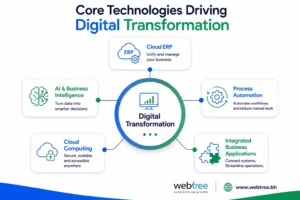
Cloud ERP: The Foundation of Modern Trading Businesses
For most trading companies, a cloud-based ERP system serves as the foundation of digital transformation. It connects critical business functions into a single platform, ensuring that every department works with the same real-time information.
A modern cloud ERP solution can manage:
- Inventory Management
- Procurement
- Finance
- Sales and Customer Management
AI & Business Intelligence
While an ERP system centralizes business operations, Artificial Intelligence (AI) and Business Intelligence (BI) transform data into actionable insights. Instead of relying on intuition or historical reports, businesses can make faster, more informed decisions using predictive analytics such as:
- Demand Forecasting
- Sales Forecasting
- Predictive Analytics
Supply Chain Automation
A responsive supply chain is essential for trading businesses operating in today’s fast-paced market. Automation minimizes manual intervention, reduces delays, and improves operational efficiency across every stage of the supply chain including:
- Warehouse Automation
- Automated Order Processing
- Shipment Tracking
B2B Customer Portals
Today’s business customers expect the same digital convenience they experience in online retail. A B2B customer portal enables trading companies to provide a seamless self-service experience while reducing administrative workloads.
A modern B2B portal allows customers to:
- Browse product catalogs
- View personalized pricing
- Place orders online
- Track order status
- Download invoices
- Access account statements
- Submit service requests
By empowering customers to manage routine transactions independently, businesses improve customer satisfaction while allowing their sales teams to focus on building stronger relationships.
IoT & Smart Logistics
The Internet of Things (IoT) is helping trading companies gain greater visibility across their logistics operations through connected devices and real-time monitoring, including:
- Asset Tracking
- Fleet Monitoring
- Real-Time Visibility
What Does a Digitally Transformed Trading Company Look Like?
The difference between traditional and digitally transformed operations is significant. Modern technologies provide greater visibility, faster workflows, and improved decision-making across the business.
| Traditional Operations | Digital Operations |
|---|
| Manual inventory tracking | Real-time inventory visibility |
| Paper invoices and documents | Digital documentation and e-invoicing |
| Spreadsheet-based reporting | Live dashboards with business analytics |
| Orders via phone or email | Online B2B customer self-service portal |
| Manual approvals | Automated approval workflows |
| Separate software systems | Integrated ERP platform |
| Reactive decision-making | AI-powered predictive insights |
| Limited supply chain visibility | End-to-end supply chain monitoring |
This transformation is not simply about adopting new software. It is about creating a connected business where information flows seamlessly across departments, enabling faster decisions and greater operational efficiency.
Benefits of Digital Transformation
Digital transformation delivers measurable business outcomes that extend beyond operational improvements.
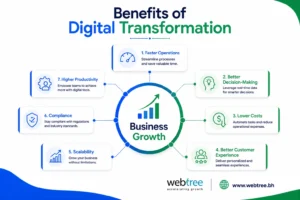
Faster Operations
Automation reduces repetitive administrative tasks, accelerates approvals, and shortens order processing times, allowing businesses to serve customers more efficiently.
Better Decision-Making
Real-time dashboards and AI-powered analytics provide management with accurate business insights, enabling quicker and more confident strategic decisions.
Reduced Operational Costs
Automating manual processes reduces administrative expenses, minimizes errors, optimizes inventory levels, and improves resource utilization, leading to lower operating costs.
Improved Customer Experience
Customers benefit from faster response times, accurate inventory information, online ordering, shipment tracking, and greater transparency throughout the purchasing process.
Greater Scalability
As trading businesses expand into new markets or increase transaction volumes, cloud-based digital systems scale without requiring major infrastructure investments.
Better Compliance
Integrated systems simplify financial reporting, audit preparation, tax compliance, and regulatory documentation by maintaining accurate digital records.
Higher Productivity
Employees spend less time on repetitive administrative work and more time on customer engagement, supplier management, and strategic initiatives that drive business growth.
How AI Is Changing the Trading Industry
Artificial Intelligence is no longer a futuristic technology—it has become a practical tool that helps trading companies improve efficiency and make smarter decisions.
Some of the most valuable AI applications include:
- Intelligent Demand Forecasting
- Smart Inventory Optimization
- Sales Predictions
- Customer Service Chatbots
- Automated Reporting
It is important to note that AI complements ERP systems rather than replacing them. ERP systems serve as the foundation for business operations, while AI enhances the data generated by these systems to support better decision-making.
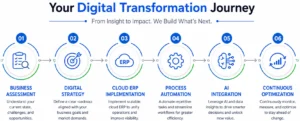
Choosing the Right Digital Transformation Partner
Successful digital transformation depends as much on the implementation partner as it does on the technology itself.
When evaluating a digital transformation provider, consider the following factors:
Industry Expertise
Choose a partner that understands the operational challenges faced by trading companies, including procurement, inventory management, logistics, and finance.
ERP Implementation Experience
A knowledgeable implementation partner can customize ERP solutions to align with your existing workflows, ensuring smoother adoption and faster return on investment.
Custom Software Development
Every trading business has unique processes. Custom software capabilities ensure that digital solutions address your specific operational requirements rather than forcing your business to adapt to generic software.
Cloud Solutions
Look for expertise in cloud migration, cloud infrastructure, and secure deployment to ensure long-term scalability and business continuity.
AI Integration
As AI becomes increasingly valuable, partnering with a provider experienced in AI-powered business solutions can help future-proof your investment.
Ongoing Support
Digital transformation is an ongoing journey. Continuous support, software optimization, employee training, and system enhancements are essential for long-term success.
Bahrain’s Digital Transformation Ecosystem
Bahrain has established itself as one of the GCC’s leading digital economies by investing heavily in cloud infrastructure, innovation, and business-friendly technology initiatives.
Several factors make Bahrain an ideal environment for digital transformation.
- Bahrain’s Cloud First Policy encourages government organizations and businesses to adopt cloud technologies where appropriate, accelerating digital adoption while reducing infrastructure costs. Cloud adoption across the Middle East is evolving beyond infrastructure modernization into a strategic foundation for innovation, resilience, and AI adoption, according to PwC’s regional cloud survey.
- AWS Bahrain Region has strengthened the country’s cloud ecosystem by providing businesses with secure cloud services hosted within the region.
- Tamkeen Support Programs play an important role in helping Bahraini businesses improve competitiveness by supporting workforce development, digital adoption, and business modernization initiatives.
- Ministry of Industry and Commerce Initiatives promote digital innovation, entrepreneurship, and smart business practices that contribute to Bahrain’s growing digital economy.
Together, these initiatives create a favorable environment for organizations looking to accelerate their digital transformation journey and remain competitive within regional and international markets.
How Webtree Can Help
At Webtree, we believe technology should solve real business challenges, not create new ones. Our approach focuses on aligning digital solutions with measurable business outcomes, whether that means reducing operational costs, improving supply chain visibility, enhancing customer experiences, or enabling data-driven decision-making.
Every trading business has unique operational challenges, and successful digital transformation requires solutions tailored to those needs. At Webtree, we go beyond software implementation by helping businesses build connected, intelligent, and scalable digital ecosystems.
- Our digital transformation services include:
- Digital transformation consulting
- ERP implementation and customization
- Custom software development
- AI-powered business solutions
- Supply chain automation
- B2B customer portal development
- Cloud migration and integration
- Ongoing support, optimization, and training
Whether you’re modernizing an existing system or building a fully integrated digital platform, our team works closely with you to develop solutions that improve efficiency, enhance visibility, and support sustainable business growth.
Explore how Webtree has helped businesses modernize operations through tailored digital transformation solutions and discover how the right strategy can create lasting business value.
Ready to Digitally Transform Your Trading Business?
The future of trading belongs to businesses that embrace innovation, automation, and intelligent decision-making. By investing in digital transformation for trading companies in Bahrain, organizations can streamline operations, strengthen supply chains, improve customer experiences, and build a competitive advantage in an increasingly digital marketplace.
Whether your goal is to implement a cloud ERP Bahrain solution, automate supply chain processes, develop a B2B customer portal, or integrate AI-powered business intelligence, Webtree has the expertise to guide your transformation journey.
Contact Webtree today to discover how our digital transformation services can help your trading business operate smarter, grow faster, and stay ahead in Bahrain’s evolving digital economy.
Frequently Asked Questions
How does ERP help trading companies?
ERP centralizes inventory, procurement, finance, sales, and reporting into a single integrated platform. This improves visibility, eliminates duplicate work, and streamlines day-to-day operations.
Is digital transformation expensive?
The investment depends on the size and complexity of the business. Many organizations adopt a phased implementation approach, allowing them to realize business benefits gradually while managing costs effectively.
How can AI benefit trading companies?
AI supports demand forecasting, inventory optimization, predictive analytics, sales forecasting, automated reporting, and customer service automation, enabling businesses to make smarter operational decisions.
Are there digital transformation initiatives in Bahrain?
Yes. Bahrain actively supports digital transformation through initiatives such as the Cloud First policy, AWS Bahrain Region, Tamkeen support programs, and various government-led efforts that encourage technology adoption and digital innovation.